Multiple Classics of the Genre Look at 40

by William Moon
NOTE: This article originally ran on scifigangstas.com in June 2022
June 1982 was a fat month for movie releases. In an era now where studios fight over release date real estate much like jackasses fight over smart TVs on Black Friday, the logjam of movies released in June of ’82 looks like a misprint. Here’s the (North American) toteboard.
June 4th – Star Trek II: The Wrath of Khan, Poltergeist, Hanky Panky (note – We, uh, will not be discussing Hanky Panky any further in this article.) – Khaaaaaan unseated previous box office champ Rocky III, which had been released the prior weekend. The top genre film at the time was the action fantasy Conan the Barbarian, which had been out for three weeks.
June 11th – E.T. the Extra-Terrestrial, Grease 2 (Hey, everyone, it’s Michelle Pfeiffer! And literally nobody else.) – E.T. crushed everything in its path on the way to becoming the highest-grossing film of all-time, with that path being pretty stacked.
June 18th – Firefox, Author! Author! – This weekend was less memorable, though those films do star Clint Eastwood and Al Pacino respectively.
June 25th – Blade Runner, The Thing, Megaforce (You might think something with this title would be bitchin’ awesome. It is not.) – E.T.‘s rampage at the box office most heavily affected this weekend, with future cult classics Blade Runner and The Thing making that necessary first step towards cult classicdom by flopping pretty hard.
(For the record, the only new films the first two weekends of July were The Secret of NIMH and Tron, respectively, which also fell at the feet of America’s lord and master E.T.)
To recap, Steven Spielberg saw Poltergeist (which he co-wrote, co-produced, and reportedly ghost co-directed) released one weekend, then backed that up with E.T. the following weekend, which set fire to the box office and straight-up wrecked the financial fortunes of most of the movies that came out over the next couple of months. The adventures of Elliott and his new pal stayed in the top five moneymakers clear through to mid-December, with its run at number one only briefly halted at different points by films as diverse as The Best Little Whorehouse in Texas, Friday the 13th Part III, and An Officer and a Gentleman through to Labor Day weekend. While Spielberg famously split apart his original Watch the Skies/Night Skies project into the more monstrous Poltergeist and more kid-friendly E.T., the real monster was just what he was about to do to America’s wallets.
I say all that to say that it could’ve been easy in those halcyon days of E.T.-mania to dismiss those underperforming other films, or even the much more modest success of something like Star Trek II. But time, as it so often does, has had its strange, often unpredictable effect. When you look at best of sci-fi lists these days, including this one put together by some asshole, it’s often Blade Runner that takes the top spot, if not all-time, then at least among the Class of ’82. (Check lists from sites more reputable than my dumbass opinions here, here, and here. Blade Runner is first or second all-time in all of them.) The Thing and Star Trek II are also well-represented on such lists, too, sometimes ahead of E.T., sometimes just behind it. This is not to knock on E.T. or even its outsized success. E.T. is wonderful, one of those films that defines a certain era, a certain adolescent time in our lives so well (and so marketably) that Hollywood’s been chasing that vibe ever since without quite recapturing it. But it’s just one key component in a year that hit us repeatedly with science fiction magic of all types. And on a round-number anniversary, let’s take a look back at the towering legacy those films have left us.

In my write-up for E.T. on the sci-fi list linked above, I got onto some spiel about how Spielberg essentially cracked a Hollywood cheat code, one where he could generate real movie magic, the kind of stuff most filmmakers can only dream of, and do it regularly enough to commoditize it. It’s all very similar in tone to some of the light barbs about the movie’s box office take that were lobbed earlier in this article, but I have to stress that I don’t mean any disrespect to Spielberg. There’s nothing necessarily wrong with making movies that earn gobs and gobs of money as long as there’s something actually worthwhile about them. (I mean there almost certainly is, what with the gross way Hollywood often does business, but I don’t want to get into those weeds in an article like this, if at all.) E.T., like Close Encounters of the Third Kind before it and Jurassic Park after it, is one of those movies that defines a four-quadrant hit, i.e. a movie that does well with male and female audiences of all ages. Hits like these are, again, what made the major studios chase that kind of formula for so long afterward before steering hard into the current franchise-making model. Science fiction has been well represented over the years in these mass appeal tentpoles, with Terminator 2, Jurassic Park, Independence Day, Avatar, Inception, and, sigh, the Transformers franchise among many to reap major financial rewards from big-budget slam-bang sci-fi thrills.
Child characters pop up here and there throughout the films in that short list above, particularly in Jurassic Park, but big-budget kid adventure movies became all the rage in the years after E.T.‘s release, with hits like The Goonies and misfires like Space Camp and Explorers trying to make hay in its wake (and those are just a few examples). And of course that nostalgia for Spielbergian adolescent wonder runs all through Neflix’s hit Stranger Things, which pulls together elements of several of the films this article will talk about plus a few others to create its warm, loving pastiche of ’80s sci-fi Americana. Spielberg himself has returned to this well on occasion, with his upcoming The Fabelmans being a semi-autobiographical story about his own adolescent years. While some of the other films released in ’82 pushed sci-fi further, these core elements of E.T. are still core elements of how many Americans want to be entertained. This Spielbergian magic was and still is undeniable. (And this doesn’t even mention John Williams, who did some of the best work of his illustrious career on this film.)

While it can’t be considered sci-fi, the other half of Spielberg’s big year is still highly influential in genre circles and at the very least does adopt a quasi-scientific approach in its take on the supernatural. As stated above, the more malevolent elements in Spielberg’s Watch the Skies/Night Skies project (originally developed as a grudging sequel to Close Encounters) were spun off into this horror collaboration with Texas Chain Saw Massacre director Tobe Hooper (with other aspects cropping up in Joe Dante’s Gremlins two years later). The amount of Spielberg’s directorial input has been debated over the years, but the film does feel like the spawn of the two men’s distinctive styles. While it made nowhere near what its sister project did, it still finished ’82 as the highest-grossing horror film of the year and the eighth-highest-grossing movie overall, successful enough to spawn two lackluster sequels and a mostly pointless 2015 remake (plus a persistent Hollywood curse). And who among us hasn’t, at least once, been mildly creeped out when a chair seems to be in a different place than where you thought it was? Or when an uncooked steak starts moving on its own? Or when you fall into a giant pit of muddy water and skeletons? Or when a clown or weird tree do literally anything? Thanks to Poltergeist, these routine, everyday occurrences now carry an extra sense of ookiness.

Opening the same weekend as Poltergeist (and one week before E.T.), Star Trek II: The Wrath of Khan basically saved its franchise. Budget overruns, a chaotic shooting schedule, and Gene Roddenberry being Gene Roddenberry had somehow turned 1979’s Star Trek: The Motion Picture into, by some accounts, the most expensive movie ever made when it finally hit theaters in December of that year. (Clearly none of that money was spent on underwear.) Producer Harve Bennett was hired by Paramount to cut costs and make a Trek movie that could make money, and he did exactly that. Onboard came director Nicholas Meyer (who would exert great influence over the remaining Trek films featuring the original cast), who used Paramount’s TV production unit to keep things moving quickly and efficiently, and they were joined by a returning Ricardo Montalban as the gloriously-chested genetic superman Khan from 1967’s “Space Seed”.
It’s hard to pinpoint exactly which elements here were the secret sauce (aside from it not costing a buttload to make this time). Meyer introduced several naval elements to the franchise, with even the now familiar red tunic uniforms looking far more military than any previous outfits worn by Starfleet. (Apparently where Roddenberry thought of Trek as a “wagon train to the stars”, Meyer saw it as “Horatio Hornblower in space”.) Also this was the movie where the 23rd-century setting was firmly established, as all prior franchise entries had simply used stardates with no clue as to how they related to real-world timekeeping. I think all of these were changes audiences responded to in some manner, but the immediate difference between Treks I and II is the nature of their villains. Where TMP used a Roddenberry staple – flying into space and encountering a god-like entity – WoK opted for the more personal threat of Khan and his quest for revenge, with Montalban and William Shatner making this conflict even more grandiose than the Enterprise meeting a god. The hammy, yet Shakespearean (and distinctly Melville-ian) battle between the pair coupled nicely with the film’s admission of its cast’s increasing age to bring the kind of stakes that weren’t really present even as entire space stations were being obliterated by Vger in the first film. And, of course, this all dovetailed nicely with the rumored and ultimately confirmed demise of Spock in the film’s finale. (Credit to Shatner, who gets rightly ragged on for his Shat-ness as an actor, but who also knocks WoK‘s final act out of the park, both the Khan and Spock scenes.)
The end result was a film that actually grossed slightly less than its predecessor (TMP reportedly tallied $139 mil to WoK‘s $97 million total), but on a much more manageable budget ($12 million as opposed to $44 million). And it charted a path forward for a franchise that somehow was still only just beginning to journey to the stars. Star Treks III and IV formed a loose trilogy with II, and Star Trek VI carried some of those elements further forward with Meyer back in the director’s chair. The box office success of IV in particular was crucial to the greenlighting of the franchise-redefining Star Trek: The Next Generation. But were it not for KHAAAAAAAAAAAAAAAAAAAANNN, those future voyages may not have happened.

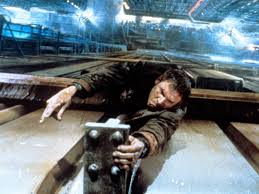
Having covered E.T. and the financially successful films released just before it, now we move to the other end of the business spectrum with the weekend of June 25th. With E.T. firmly in control of the multiplexes, two of my all-time favorite movies were released on the same day, with each one crashing and burning miserably from an economic standpoint. Ridley Scott’s Blade Runner may have given audiences the most fully-realized vision of the future seen up to that point, but even with superstar Harrison Ford front and center, the movie still opened with only $6.15 million, good for second at the box office, but still less than half of what E.T. made in its third weekend of release ($13.38 million). A sharply mixed reaction from critics didn’t help matters, and it was out of the top ten within three weeks. The film was mis-marketed by Warner Bros., who tried to sell it as more of an action-adventure than it is, and audiences and critics alike (especially in the U.S.) were put off by its deliberate pace. Of course, this was the oft-maligned theatrical cut, with its studio-mandated voiceover narration (done by an obviously irritated Ford) and out-of-place “happy” ending (which reused footage originally shot for Stanley Kubrick’s The Shining). Buried by the successes of some of its peers, the film disappeared quietly into its second life, but what a second life it’s had.
It was a happy accident in 1990 when a workprint cut of the film (which had been used in largely unsuccessful test screenings back in ’82) was mistakenly sent to a theater in Los Angeles for a showing. The movie had managed to cultivate a sizable cult audience by this point, but the existence of a version without Ford’s narration or the final scene from the theatrical release stimulated conversation about the film, with a successful campaign to see the official release of a director’s cut being mounted afterward. Scott returned to the project and released his new cut the following year, which also took out the narration and final scene, but also crucially added the now famous unicorn dream sequence that hadn’t appeared in any screened version of the film to that point. As we now know, other alternate cuts followed, with the slight changes between each one acting as a sort of dialogue that the movie’s having with its audience over the decades, culminating in the release of Scott’s Final Cut in 2007 and Denis Villeneuve’s Blade Runner 2049 in 2017. (Other related media have also been released, including sequels to Philip K. Dick’s original source novel and an anime series.)
Through this time, the film has graduated from flop to cult classic to just straight-up classic, serving still as one of the most influential movies ever made in any genre even as we’ve now sprinted past the future year in which it was set. The work of Scott, the film’s cast (particularly the late Rutger Hauer as sympathetic antagonist Roy Batty), composer Vangelis, and the particularly crucial behind-the-scenes trio of cinematographer Jordan Cronenweth, concept artist Syd Mead, and special effects designer Douglas Trumbull (a titanic figure in his field who passed away recently) has remained beyond timeless, charting at the same time a past, a future, and an alternate present that remains as rich and vibrant as it was 40 years ago.

Released the same day as Blade Runner, John Carpenter’s gory, goopy remake of Christian Nyby and Howard Hawks’ ’50s classic The Thing from Another World flopped even harder than its principal opening weekend competition. The Thing, which reteamed Carpenter with star Kurt Russell for the third time, only grossed (pun intended) about half of what Blade Runner did that late June weekend, opening all the way down in eighth place with a shade over $3.1 million. That was just good enough to keep it above mega-bomb Megaforce and a rerelease of Disney’s Bambi. And the critics were even more unkind. When scanning through the film’s initial reviews, one is struck by just how hostile most of them are. Not simply bad reviews, but borderline vicious. Keep in mind that while The Thing is a landmark in the body horror genre, it was by no means the only bloody horror picture that had hit theaters during this era. The late ’70s and early ’80s were awash with horror flicks, ranging from revered classics to idiotic nonsense and everything in between. And Carpenter had obviously made his name off the success of films like Halloween and The Fog, so it remains a curiosity that the critical establishment felt the need to get their knives out for this movie to such a degree. (Contrast this remake’s reception to that of Philip Kaufman’s 1978 take on Invasion of the Body Snatchers, which was also an update of a ’50s classic and featured unsettling visual effects and a famously downbeat ending of its own.)
The path from flop to cult classic to classic for The Thing isn’t as easy to chart as Blade Runner‘s is. There have been no prominent rereleases or director’s cuts. The film released on June 25, 1982 is still the film you can find on streaming services today. The shifting public perception of the movie is probably owed mostly to the sometimes forgiving nature of horror fandom, where mainstream failure is often seen as a badge of honor more than anything else. And like Blade Runner, The Thing had its acolytes from the get-go. Through gritted teeth, the performances of the cast (particularly Russell) and the elaborately graphic special effects work of Rob Bottin were praised even amongst the poison pen reviews. And obviously the exact kind of horror enthusiast who many of those reviewers assumed the movie was tailor-made for (in defiance of supposed good taste) really did enjoy the grotesqueries Carpenter and company put on display.
I think where the film really finally connected, though, was perhaps the one area where it couldn’t hit with audiences initially. Gore aside, The Thing is a masterpiece of dread. The extreme isolation of the Antarctic setting (using northern British Columbia as a stand-in), the body-snatcher premise, the imperfect mystery of it all (there’s no way to tell exactly who gets taken over and when, even if you watch it a million times) flow together to produce a rather nihilistic movie, even by horror standards. The cooperation between the creature’s would-be victims is hit-and-miss at best, and the film’s ending is a pretty major downer (I still remember how it affected me when I first saw it as a teenager). You don’t get much in the way of cheerable moments, which usually popped up in sci-fi and horror pictures of the previous generation, where can-do American spirit tended to overcome whatever creeping extra-terrestrial menace it ran up against. (The film’s sequence of disbelief, distrust, and then violent disagreement between red-blooded Americans in the face of a growing, clearly infectious threat couldn’t possibly have foretold anything, could it?)
No, the only thing that can stand in the face of this monster (and the movie’s strongly implied undercurrent of total planetary assimilation if it ever reached a populated area) is a complete “burn it all down” mentality. A fiery, underappreciated lead performance from Russell and his magnificent beard really drives this home, but whatever amount of triumph he and we as the audience are allowed to feel after the final confrontation is immediately undercut by the reappearance of Keith David’s Childs and the gnawing uncertainty he brings with him. It’s a perfect horror movie, packaging revolutionary gore effects, paranoia, mystery, suspense, and tons and tons of dread into 109 minutes. Its initial failure damaged its director’s career and bruised his psyche, but this is still his (and maybe all of horror’s) finest hour.

Another quick detour away from sci-fi and into supernatural horror with a sci-fi bent, we skip forward to late October and the other underperforming John Carpenter-adjacent project from this year, the complete cinematic oddity that is Halloween III: Season of the Witch. Famously the one Halloween picture that doesn’t feature Michael Myers as its villain, Halloween III was intended to establish an anthology type of franchise under the Halloween name, with the Myers/Laurie Strode story having supposedly been resolved permanently by the previous year’s Halloween II. The story, originally written by Quatermass series mastermind Nigel Kneale (a favorite of Carpenter’s), is completely batshit. It mixes robots assassins, Halloween masks, computer chips that contain fragments of a stolen Stonehenge slab, and that one gnarly scene where a kid’s head melts and a bunch of snakes and bugs crawl out and kill his parents. Like The Thing, it did not do well, and Universal Pictures and Carpenter (who produced this movie, but didn’t direct) went their separate ways afterward. The Halloween franchise also parted ways with Carpenter, and Michael Myers has hacked and slashed his way through nine films of varying quality since (with a tenth on the way this year). But this completely weird-ass movie still exists, and the world is better richer more interesting for it.

And we wind up our tour of ’82 with Tron. Released two weeks after Blade Runner and The Thing, Tron also struggled upstream at the box office against E.T., which was still sitting pretty at number one after five weeks in theaters. Tron opened in second with about $4.76 million, well below E.T.‘s $12.4 mil, but it managed to leg out a pretty solid cumulative box office take of about $50 million (on a $17 million budget), which put it solidly in the black financially speaking. Reviews were mostly positive, but not overwhelmingly so, and the film received a couple of Academy Award nominations in the technical categories (something Blade Runner also did). Neither of those nominations were for Best Visual Effects, which is very strange given that the visual effects are basically 85% of the movie, but you never know with the Academy sometimes. (For the record, only E.T., Poltergeist, and Blade Runner were nominated in that category, and E.T. won.)
The story of Tron isn’t exactly the most gripping material, but this idea of the blending of the real and virtual worlds, with a complete civilization existing within the software of a computer, was pretty in-step with the burgeoning cyberpunk sci-fi subgenre, which I wouldn’t say Tron is necessarily representative of, but sort of sits alongside in some ways. Of the movies listed here, obviously Blade Runner is far more in line with cyberpunk’s general vibe than perhaps any other film ever made, but getting multiplex audiences thinking about computers and virtual worlds in this kind of way absolutely helped pave the way for the more fully-realized storytelling of authors like William Gibson. (Akira, another cyberpunk touchstone, also began its life in 1982, as a manga series. The film adaptation would be released six years later.)
Also like Blade Runner, Tron received a belated legacy sequel, with original stars Jeff Bridges and Bruce Boxleitner returning for Tron: Legacy in 2010. That film was moderately successful, but like its predecessor, didn’t quite do enough to completely push the franchise into the mainstream. Tron remains its own unique little endeavor, a visual touchstone for a generation, but something that’s always been best enjoyed at a bit of a remove. Many of its elements seem pretty quaint now in this world of computers infinitely more powerful than anything anyone could ever have imagined in 1982 (and that now fit in your pocket), but like Blade Runner and so many other sci-fi classics, its idea of what the future of technology could look like still retains a certain power, even as the actual passing of time and pace of innovation has surged far beyond its limited scope.
For science fiction, that’s always a key element. Present becomes past, and future becomes present. Any vision of the future will eventually see the real-world version of that future come around. 2001 came and went with no monolith, the 1990s thankfully did not feature Khan’s Eugenics Wars, and the flying cars, off-world colonies and acid rain of Blade Runner‘s 2019 Los Angeles didn’t come to pass. But that also really doesn’t matter. The best sci-fi stories still retain their power even as the speculative parts of them remain purely speculative. Science fiction is ultimately really always about us, those of us who are telling the story and those of us who are hearing it, and what we have done, are doing, and will do. And the stories of 1982 have echoed powerfully over these intervening 40 years. And they will continue to echo powerfully still for as long as anyone out there listens.
 Octopus Man
Leave a comment