
by William Moon
Spoilers included for the current most recent episode of Barry, “tricky legacies”, the fifth episode of season four
As Barry draws to its conclusion, each episode is likely to generate more and more online discourse, as is so often the case when a show like this nears its end. (And here I am adding to that discourse in my own small way.) And while the general critical response to the most recent episode, “tricky legacies”, has largely been positive, Sunday night’s outing feels like one that’s destined to go down as a deeply polarizing one. It follows up on the final sequence from its predecessor, “it takes a psycho”, by affirming that the apparent time/setting jump is real (at least for now, though I highly doubt they’d reveal it’s all a dream after an entire episode this late in the run was devoted to it). Barry and Sally are now Clark and Emily, who are raising their son John out in the wide-open expanses of an unnamed location. And with that jump comes a major change in mood (from bleak to “even Werner Herzog would think this is dark” bleak).
Star Bill Hader directs an episode filled with wide shots of a kind of dusty, deeply isolated Americana, with the audience fairly consistently reminded of just how far out in the middle of nowhere our central couple find themselves. Through that, we have “Clark”, who may be a rancher or farmer of some sort but isn’t really shown doing any work aside from attempting to put up a fence with his son , and “Emily”, who works at the local greasy spoon and overtly seethes her way through this life. Poor John, the couple’s son, is cold, lonely, and deprived of even the simple pleasures of baseball in the one of the show’s trademark darkly humorous sequences. As dour as that all sounds, Barry Berkman has gotten some kind of version of what he’s wanted, at least in this season. He and Sally are together, a “normal” family who hearken back to what is apparently something approaching Barry’s own childhood, before the war and Fuches turned him into a monster. (Or unleashed the monster that was already there.) It’s here where I seize upon a possible reference point that, to my knowledge, has not been part of the discourse. (Apologies if it was and I missed it.)
Apt comparisons to other major TV series like Twin Peaks, particularly the final episode of The Return, and at least one show that I want to watch but haven’t (Better Call Saul) have been made, but I’m digging into my usual comic playbook and coming up with Alan Moore and Dave Gibbons’ seminal 1985 Superman comic “For the Man Who Has Everything” (Superman Annual #11). (This comic has been more directly adapted already in episodes of Justice League Unlimited, Supergirl, and Krypton.)
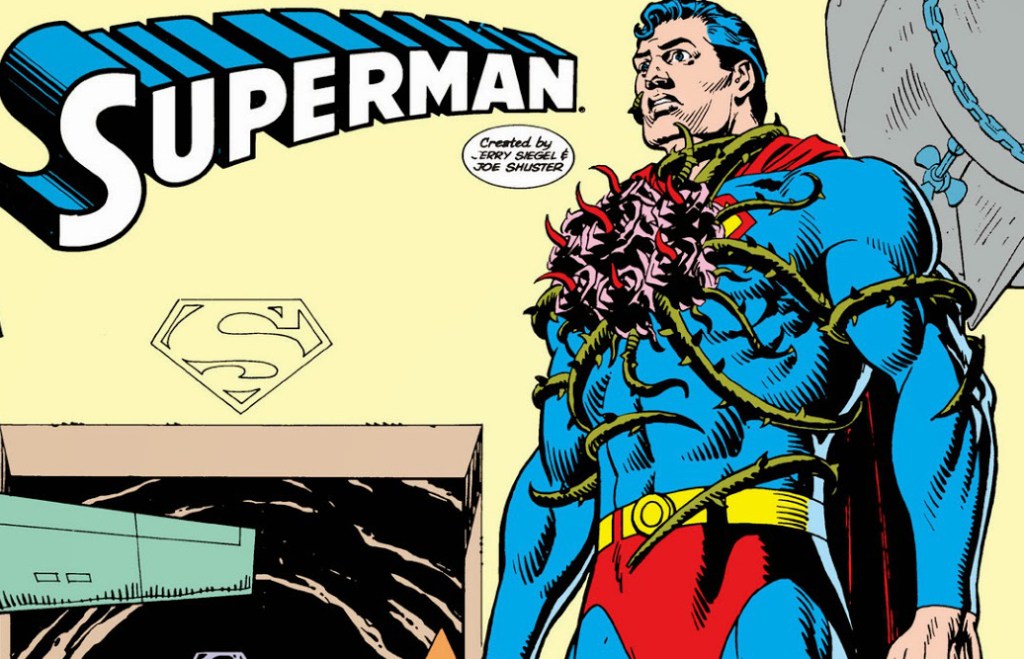
First off, Barry’s chosen Clark as his new name, he’s working hard to rewrite himself as a war hero who’s inspired by and interested in the stories of other heroes like Abe Lincoln, and you could read a certain Smallville-ness into his new surroundings. But also let’s go back to the main conceit of the episode – that Barry has gotten exactly what he wanted. Superman gets that, too, courtesy of the alien Black Mercy plant attached to him by the villain Mongul, and while the hallucination the plant induces keeps the hero entranced as per Mongul’s plan, the actual content of Kal-El’s vision is nowhere near as idyllic as you would expect.
In this world, Kal is a husband and father back on a non-exploded Krypton, and on the surface, his domestic situation is fairly positive. But Kryptonian society is coming apart at the seams, and Kal’s father Jor-El is heavily involved. Jor-El had preached about Krypton’s looming destruction in this reality as well, only this time it didn’t happen, which left him humiliated and ostracized. This humiliation combines with the subsequent deaths of both his wife and brother to leave Jor-El, and by extension Kal and his family, isolated from the rest of the House of El. It also fuels Jor-El’s deeply embittered views on what he sees as an increasingly decadent Kryptonian society, with him going so far as to become chairman of an extremist faction looking to establish a theocracy on the planet. As Kal tries to reason with his father, we see increasing fallout from Jor-El and his acolytes’ actions. While the Mercy’s vision wasn’t truly his heart’s deepest desire, Superman does have to bid his fictitious son a tearful goodbye before breaking free from the Mercy’s hold.

There’s not a one-to-one relationship between these two stories, if there’s any relationship at al, as the darker aspects of Barry’s “dream” are different. But the feeling is the same. He has the wife, the son, and the quiet home life he’s wanted. But Sally is almost completely off the rails in this reality, and his son is miserable in ways neither he nor Barry seem to have the capacity to understand. And this is a far cry from Barry’s earlier, season one-era fantasies, where he’s a successful actor living in LA with Sally and hanging out with A-listers like Jon Hamm. It’s possible I’m stretching here, I admit, since the series seems to take a fairly dim view of at least comic book movies if not comics themselves. (Note the ad for Mega Girls 4 in the episode, with Kristen from “it takes a psycho” now the franchise lead). But it’s just a thought.
How will it impact the show’s endgame? Not sure. Superman awakes from his dream and ultimately saves the day, but that’s almost certainly not what’s going to happen with Barry. His dream is real, but it’s shattered in an entirely different manner by the reappearance of Gene back in Los Angeles. This series has been heading for a much darker ending than any Superman story for quite a long time now, at least since Barry killed Chris back in season one. But if Bill Hader and Alec Berg wanted to blow up the show’s general vibe just to show what would happen if our protagonist got exactly what he thought he wanted, “For the Man Who Has Everything” would be an excellent starting point.
 Octopus Man
Leave a reply to danielkelly10351082 Cancel reply