by William Moon
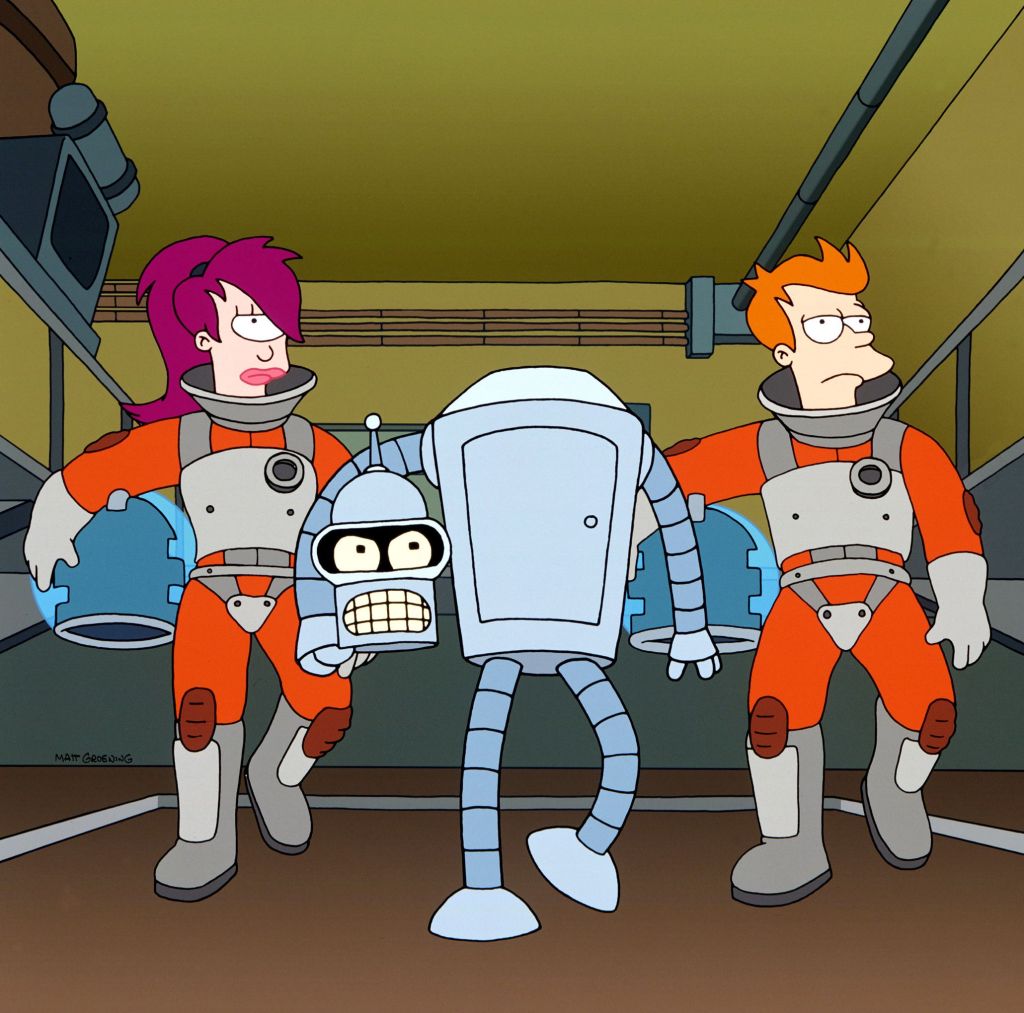
It can be easy to forget since we still don’t have any firm release date, but Hulu has revived Futurama from its cryonic stasis once again. The first half of the series’ 20-episode order is slated to drop sometime this summer, and after an initial delay, all of the show’s original regular voice cast has signed on. Futurama is probably still my favorite TV show of all time, and with its fourth incarnation imminent, it’s time to revisit a geek and comedy culture touchstone.
I’m a list-maker to the core (much like Liam Neeson), but I’m not entirely sure a list of its best episodes can really cover the brilliance of Futurama. (Several other websites have tried this, if that’s what you’re looking for.) The show is so densely packed with sight gags, running jokes, deep cuts from both sci-fi and actual science, and a dedication to plot and character development rarely seen in its animated contemporaries that even its lesser episodes usually contain flashes of brilliance. For example, season three’s “I Dated a Robot”, normally considered one of the show’s weaker efforts, features both this excellent gag and this propaganda film spoof. (All of the instructional/educational videos in the series are classic.) So, with that in mind, let’s just take a tour through one of TV’s most rewatchable shows.
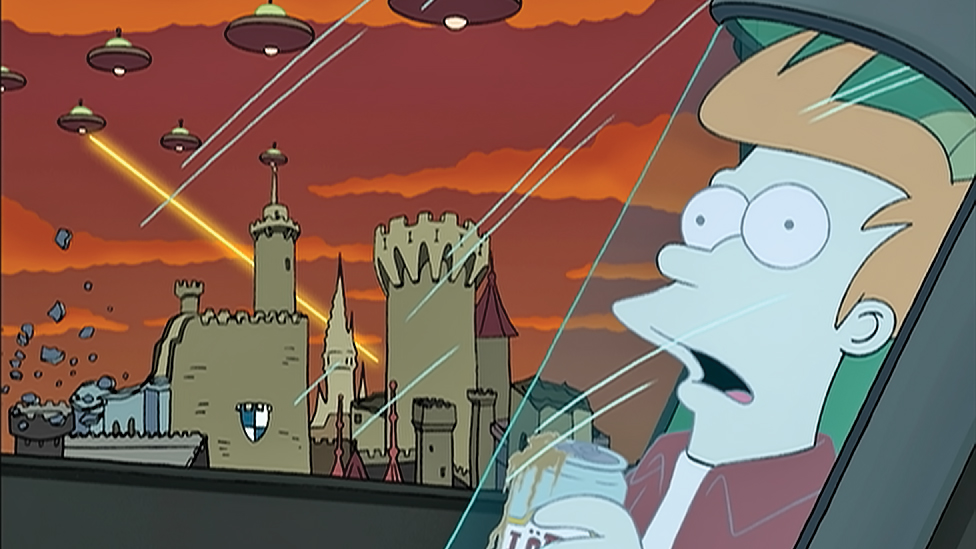
The series’ pilot episode, 1999’s “Space Pilot 3000”, succeeded in many areas. It established the show’s main trio (Fry, Leela, and Bender), plus it generally introduced us to the tongue-in-cheek vibe of New New York and the year 3000. The “world of tomorrow” bit from this article’s title is also lifted straight from the first words Fry hears when his cryonic tube opens. Plus, we get hints of two of the show’s longest-running threads – the alien language and the shadow under the desk at the cryonics lab. (It feels weird using “cryonics” and not “cryogenics”, but cryonics is technically correct, the best kind of correct.) But the gag that feels the most representative to me of the show’s humor is the one that plays out while Fry is frozen. I can’t put my finger on why, but I never fail to laugh when the flying saucers destroy everything, a new world is slowly rebuilt, and then the same flying saucers come back and destroy everything again. That’s just classic comedy.
From there, the first season has a unique vibe, as it hews closest to the core “schlub from the present wakes up in the distant future” concept, which gives the episodes plenty of chances to build the year 3000 out with whatever goofy sci-fi nonsense the writers wanted to include. (Note – when I refer to seasons, I mean the show’s production order, not the random order in which Fox aired it.) Some of this world-building and tone-setting was done in the form of cold opens, which were largely phased out later on.

As the series progressed, an overarching plot began to take shape, one which had its roots in the aforementioned “shadow under the desk” from the pilot episode. Season three’s “The Day the Earth Stood Stupid” established part of it, introducing the Nibblonians and the Brain Spawn, while the following season’s “The Why of Fry” largely brought it all home. Alongside these episodes, the series was able to regularly veer into more dramatic territory, more so than pretty much any other American animated program of the time, with emotional episodes regarding the Fry/Leela relationship (“The Sting”, “The Devil’s Hands Are Idle Playthings”), Fry’s time displacement (“The Luck of the Fryrish”, “Jurassic Bark”), and Leela’s true nature (“Leela’s Homeworld”) mixed in, plus intriguing “big questions”-type episodes like season four’s “Godfellas”. It’s probably this element that sets the show apart from its contemporaries the most, and it certainly reverberated down through subsequent narratively ambitious animated series like Adventure Time and Steven Universe.
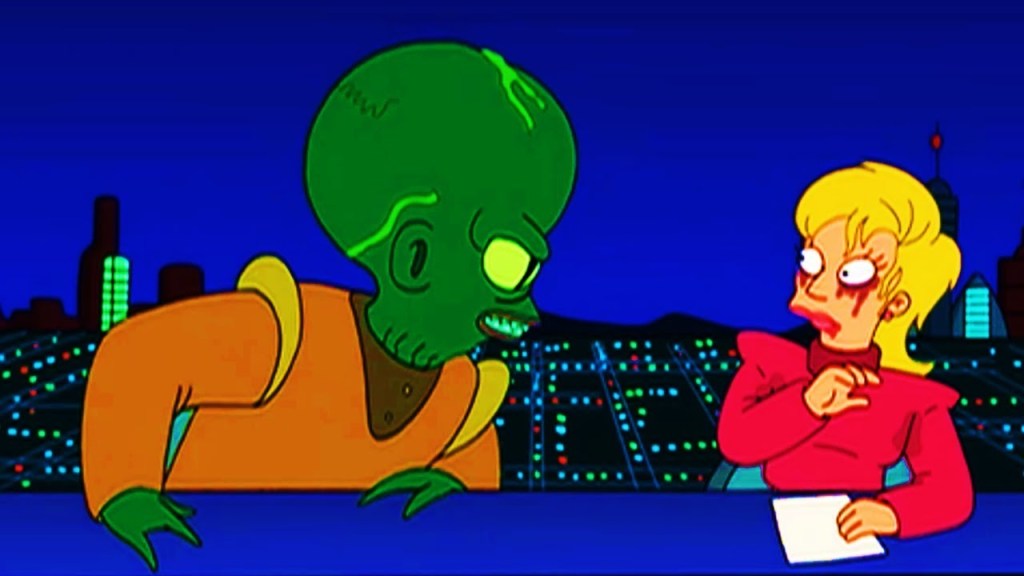
But through it all, Futurama is just really funny. There’s no way to capture it all, but anyone who’s watched the whole show probably has taken several one-liners from the series and sprinkled them into conversation over the years. Lines such as…
- “With blackjack and hookers!” (season one’s “The Series Has Landed”)
- “In your face, Gandhi!” (season two’s “Mother’s Day”)
- “You win again, gravity!” (season three’s “Amazon Women in the Mood”)
- “I thought you was corn.” (season three’s “A Tale of Two Santas”)
- “You watched it. You can’t unwatch it.” (season three’s “Anthology of Interest II)
- “Awesome. Awesome to the max.” (season three’s “Future Stock”)
- “Windmills do not work that way!” (season four’s “Crimes of the Hot”)
- “We’re owl exterminators.” (season five’s “Bender’s Game)
- “Shut up and take my money!” (season six’s “Attack of the Killer App”)
- “I don’t want to live on this planet anymore.” (season six’s “A Clockwork Origin”)
That’s just ten lines out of a possible bazillion. The show was equally adept at developing gags within episodes or over the course of full seasons. Examples of this again abound, but the “Silence!” scene in season one’s “Fear of a Bot Planet” is a great example of the series enhancing a joke by bludgeoning you with it. (This episode also introduces blernsball, the futuristic baseball equivalent which has rules that intentionally remain just outside the realm of human understanding, much like cricket.)
Season two’s “How Hermes Requisitioned His Groove Back”, not often included on best episode lists (it was on only one of the lists I linked in the first paragraph), is chock full of these jokes, with many of them culminating in the episode’s closing musical number. But the manner in which Hermes, unwittingly sent to a forced-labor camp by Dr. Zoidberg, manages to streamline the operation to the point where all the work is done by “a single Australian man” is just magnificent. (The read on that line by Dawnn Lewis, who voices Hermes’ wife LaBarbara, is truly stellar.) The Number 1.0 character is also a home run. He has only a handful of lines, but all of them are great.
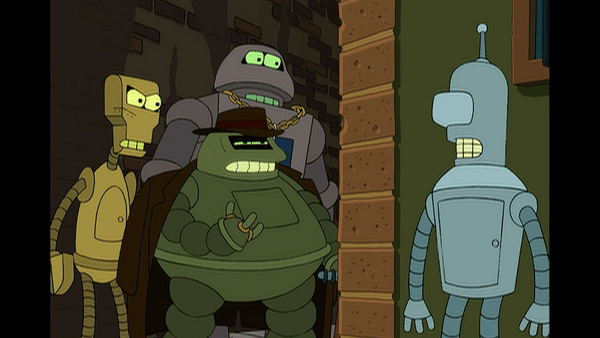
Following on from that, while the roster of regular characters is strong (Bender and Professor Farnsworth are lovably evil in their own ways and Dr. Zoidberg is a true one-of-a-kind), it’s often the random side characters who steal the show. There’s again a nearly endless amount of them – Morbo, Lrrr and Nd-Nd, Zapp and Kif, Nixon’s head, Mom and her three idiot sons, Roberto, Tinny Tim – but the Robot Mafia may have the highest batting average of the lot. The word “clamp” will never be the same, and the underplaying of most of the lines delivered by the Donbot and Joey Mousepad (both voiced by John DiMaggio) always makes those lines land a little harder. (Explaining this joke to someone who hasn’t seen it is impossible, which is sad because it’s one of my favorites in the whole series.)
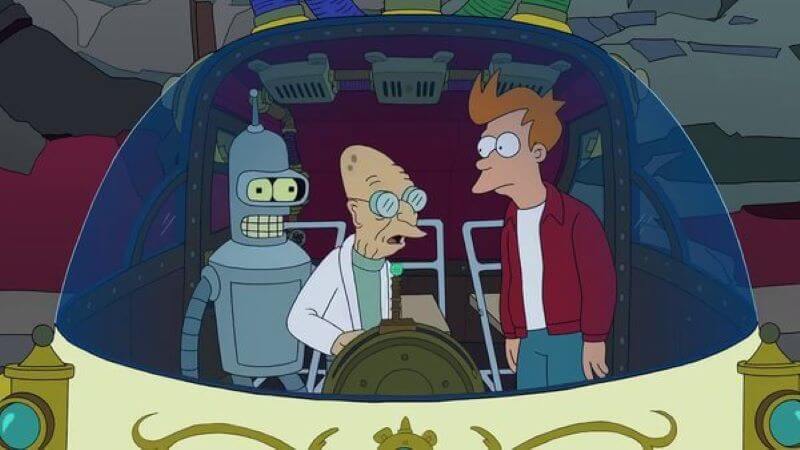
The original run of the series ended all the way back in 2003, which feels like a trillion years ago now, with two revivals having already happened. The first saw the release of four straight-to-DVD movies from 2007 to 2009, and the second contained two seasons’ worth of new episodes that aired on Comedy Central from 2010 to 2013. The hit ratio on those episodes certainly isn’t as high as it was during the original Fox years, but there were still many highlights. I prefer Bender’s Game among the four movies, though opinions vary on that. From the Comedy Central years, episodes like “The Prisoner of Benda”, “Game of Tones”, and “Murder on the Planet Express” really stand out, as does at least this one running gag from the Fast and Furious riff “2-D Blacktop”.
But the real highlight of the show’s second/third eras is season six’s “The Late Philip J. Fry”, which is no less than one of the greatest TV episodes of all time. Breaking away from the series’ habit of mining Fry’s past (and our present) for emotional depth, this one sends Fry, Bender, and the Professor hurtling into the future in a one-way time machine. The results are stunning, simultaneously digging into the core Fry/Leela relationship while also indulging in a heavy scientific view of the end of the universe and including several excellent gags. It’s the show at its very best.
So as we sit 20 years (dear Zod, I’m old) from the show’s original end and ten years from its third finale, we (or at least I) eagerly await yet another round of the greatest of all animated series. There’s so much more genius that wasn’t even touched on here (the Star Trek episode, the alternate universe episode, Action Delivery Force) that I feel encouraged that the writers/directors/voice actors/Zombie Jesus can cook up something worthy of the show’s legacy.
Here’s a quick list of my favorites episodes to wrap us up.
- “The Late Philip J. Fry”
- “The Why of Fry”
- “Amazon Women in the Mood”
- “The Sting”
- “The Luck of the Fryrish”
- “Roswell That Ends Well”
- “Parasites Lost”
- “Where No Fan Has Gone Before”
- “Jurassic Bark”
- “Fry and the Slurm Factory”
- “Anthology of Interest II”
- “The Farnsworth Parabox”
- “A Big Piece of Garbage”
- “The Devil’s Hands Are Idle Playthings”
- “Godfellas”
- “When Aliens Attack”
- “The Prisoner of Benda”
- “Teenage Mutant Leela’s Hurdles”
- “Murder on the Planet Express”
- “Xmas Story”
(Note – Scruffy the janitor would’ve been included in this article, but there was a schedule conflict.)
 Octopus Man
Leave a comment