
It seems most of us are generally aware that a hearing was held in the US House of Representatives the other day that discussed UFOs (or UAPs as they were mostly called) and aliens. David Grusch, a former USAF intelligence officer and one of three whistleblowers called to testify, alleged that the government has recovered both craft and “biologics” with “nonhuman” origins. Of course, that quickly became the main – and for many people, only – real takeaway from the hearing, which was otherwise more concerned with UAPs as a national security threat (seeing as how they could be advanced spycraft sent by hostile governments) and as yet another way to accuse the federal government of masterminding a massive conspiracy (though at least this one has a more pleasing old-school vibe than most recent conspiracy theories).
Grusch, of course, lacked any kind of definitive evidence, merely saying he’d interviewed people who’d seen this stuff firsthand. This led the skeptics among us to dismiss his testimony (if they were even paying attention to it in the first place), while longtime UFO enthusiasts like Blink-182 guitarist Tom DeLonge took it as ironclad proof that aliens exist and the government has been covering it up X-Files style. I’m not here to really wade into that debate all that much. I don’t particularly trust the government, but I also don’t really believe they’re capable of pulling off all the nefarious plots they’re often accused of perpetrating. And this isn’t the first time we’ve heard allegations similar to Grusch’s.
But none of that really matters anyway, and that’s the crux of what I want to discuss here. If Grusch is telling any kind of the truth, if DeLonge and his ilk have been correct this whole time, then the government covering up it all up isn’t even one of the 100 most important implications of it. What the government did or didn’t do would hardly matter at all, really, because everything about human existence would be fundamentally and permanently altered in the most profound possible way.
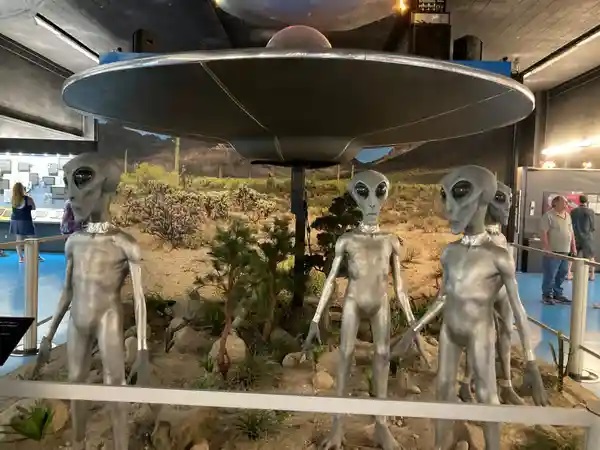
We’ve been watching aliens run around in popular sci-fi movies/shows/books/comics for multiple generations now, and perhaps the ubiquity of that genre has taken the wonder out of the possibility of extraterrestrial existence. After all, you can see a different alien pretty much every day in a major Hollywood production (current strikes aside). And I admit I love the mid-century fascination (starting with Kenneth Arnold’s famous 1947 sighting) with little green men, flying saucers, and the like. It’s a meaningful piece of American history and itself reflects and is reflected in both the real-life Space Race of the time and the Golden Age and New Wave of Science Fiction. (I’m fascinated with cryptids, too, without necessarily believing in them, as they carry a meaning in what they say about us that goes beyond whether they actually exist or not, much like how our horror fiction reflects our own real fears and anxieties as well as things that seem unknowable to us.)
But make no mistake – there’s nothing in recorded history that would compare to such a revelation. I’ve long held the belief that the only two truly meaningful things humanity has ever done are successfully land people on the Moon and launch probes that have reached interstellar space. Mankind’s future (if it has one) is in the stars, and these accomplishments are the greatest achievements in that arena. Hopefully we eclipse them in the relatively near future by expanding the scope of our space exploration.
But scientifically verifiable evidence of extraterrestrial life would be a massive discovery, greatly eclipsing literally anything else that’s ever happened. The implications would be as far-reaching as one can imagine, and there would be several of them. While man has long held a fascination with the notion of life on other planets, our society has developed over the centuries with this being treated as a fringe theory at best.
For example, despite what late-night History Channel programs might suggest, there’s nothing in any of the major religions that allows for aliens to exist without raising some pretty unanswerable, and suddenly very tangible, questions. How could the Bible or the Quran or any other major sacred text be considered the true word of God if they don’t make any mention of these other lifeforms that God created on another planet? Would the faithful have to imagine extraterrestrial equivalents for holy figures like Jesus, Muhammad, or Buddha?

Religion, which whether you ascribe to it or not has been a foundational influence on human development, has always been centered around this planet and its inhabitants, and the existence of at least one more advanced civilization on a far-off world raises theological questions large and small. Taking the unanswerable, unknowable bits of religion on faith (and reconciling often irreconcilable scientific evidence with religious doctrine) is a big part of pretty much all major belief systems, but this revelation would strain that faith harder than it’s ever been strained before.
And if potentially crippling all of organized religion in one fell swoop wasn’t enough, then how about the technological implications of how the UFOs in question reached Earth in the first place? Either these aliens would have to live in our solar system without us ever having discovered them before or they’ve created a propulsion system that allows them to make the journey to Earth in a survivable amount of time. The first one would be pretty mind-blowing and is very hard to swallow even in the fanciful hypothetical we’re engaging in here. But the second option would be just as significant as any other aspect of this discovery.

The distances between celestial objects are just unfathomably vast. I could throw numbers at you all day, but they’re all so big that it’s virtually impossible for the human brain to truly comprehend them. For most of us (and I don’t entirely exclude myself from this), once a number gets big enough, then all those big numbers just start to run together. But, no, those numbers continue to grow and grow beyond our basic understanding. The closest star to the Sun is Proxima Centauri, and that star is about 4.2465 light-years away. That equates to about 24,963,582,647,224 miles, i.e. almost 25 trillion miles. And that’s the closest star to our solar system. Voyager 1, the fastest-moving of the probes that’s entered interstellar space, is traveling at over 37,800 mph. If it were headed to Proxima Centauri (it’s not), it would take over 75,000 years to get there.
So I say all that to say that whatever means of propulsion an alien would need to reach Earth would need to be something that has only existed in the realms of science fiction. I’d say it only exists in theory, but Einstein’s theory of relativity should preclude such technology from existing. And even in most mainstream sci-fi franchises like Star Trek, Star Wars, Dune, etc., faster-than-light-speed travel is accomplished by folding space or entering an alternate dimension or something like that. Nobody ever just goes so fast that they literally traverse the entire distance between stars. There’s always a technobabble (or tongue-in-cheek) cheat of some kind.

So, again, the existence of such technology would be a discovery of unbelievable magnitude. The main thing keeping us from spreading out into the stars like so many fictional human characters have done would potentially be wiped away. The many ills of planet Earth, particularly its alarmingly warming climate, would suddenly have… Well, not a solution necessarily, but a way for us to get around them by simply upping stakes and moving elsewhere. We can’t even get to Mars right now, and here we’d have the ability to potentially send living, breathing people to another solar system.
I’d love nothing more than for us to actually make first contact with an alien race during my lifetime. The word “profound” doesn’t even really do justice to what that experience would be like. And I love sci-fi as much as (and probably much more than) the next person. But if we’re going to start talking seriously about how aliens exist and the government’s been covering it up and yada yada yada, then let’s really all stop and consider the stakes. They could not possibly be any higher.
 Octopus Man
Leave a comment